SOP for Chemical Engineering is one of the most important documents you’ll submit when applying to universities abroad, and it can genuinely make or break your admission chances. Unlike your transcripts or test scores, this is the one part of your application where the admissions committee actually hears your voice, your motivation, and your plans for the future.
A well-written Statement of Purpose for Chemical Engineering does more than list your achievements. It tells a story — why you’re drawn to processes, reactions, and materials, and why this particular university is the right place to take that interest further. Get it right, and it becomes the strongest part of your application. Get it wrong, and even a strong academic record can lose its shine.
In this guide, we’ll walk through everything you need to know: what an SOP actually is, how to structure one, how it’s different from a Personal Statement, and what to keep in mind whether you’re applying for a Bachelor’s, Master’s, MS, or PhD program.
Get the Best SOP Writing for UK, USA, Canada, Germany, Australia and more
Struggling while writing your SOP for Admission?
Get expert SOP writing help online to ensure top-quality, plagiarism-free, and well-researched content tailored to your academic needs.
 Call Us
 WhatsApp
Trusted by 20,000+ students | 95% Success Rate | Free Revisions Included
What is an SOP for Chemical Engineering?
An SOP, or Statement of Purpose, is a personal essay that explains why you want to study Chemical Engineering, what has prepared you for it, and where you see yourself after completing the degree.
Universities ask for it because:
- Grades and test scores show what you’ve achieved, not why you want to pursue this field
- It helps admissions committees understand your motivation and career direction
- It reveals your communication skills and clarity of thought
- It shows whether you’ve researched the specific program and university properly
For a field like Chemical Engineering, your SOP also needs to reflect genuine curiosity about the subject — whether that’s process design, petrochemicals, biochemical engineering, materials science, or environmental engineering. Vague enthusiasm doesn’t work; specificity does.
✔ Answer to University Prompts
Your SOP must clearly answer all the prompts specified by the university. If there are no writing formats, you must ensure that you include all the essential details such as academic background, career goals, reasons for choosing the university and course, and how the program aligns with your future aspirations. A well-structured SOP improves your chances of getting accepted.
How to Write an SOP for Chemical Engineering
Writing a strong SOP isn’t about sounding impressive — it’s about being clear, specific, and honest. Here’s how to approach it:
- Start with a real hook. Avoid generic openings like “Since childhood, I have been fascinated by chemistry.” Instead, mention a specific project, internship, or problem that pulled you toward the field.
- Connect your background to the course. Talk about relevant coursework, labs, internships, or personal projects — a plant design project, a lab research paper, a process optimization exercise.
- Explain your “why this university” clearly. Mention specific faculty, research labs, or course modules that align with your interests.
- Show a clear career direction. Whether it’s process engineering, sustainable energy, pharmaceuticals, or research, tie your goals back to the degree.
- Keep it structured. Use clear paragraphs: introduction, academic background, why this course, why this university, career goals, conclusion.
- Edit ruthlessly. Cut anything that doesn’t directly support your case. Every sentence should earn its place.
- Proofread multiple times. Grammar mistakes in a technical SOP can undercut your credibility.
Personal Statement for Chemical Engineering
A Personal Statement for Chemical Engineering is closely related to an SOP but isn’t always identical to it. Some universities — particularly in the UK — use “Personal Statement” as their preferred term instead of SOP.
A Personal Statement usually:
- Focuses more on your personal journey and character, not just academic fit
- Is often shorter and more narrative in tone
- Is commonly required for UK undergraduate applications via UCAS
- May be used interchangeably with “SOP” depending on the country and university
Always check the exact terminology and word limit required by your target university before writing, since some universities want a Personal Statement instead of, or in addition to, an SOP.
SOP vs Personal Statement
Here’s a quick comparison to keep the two straight:
| Aspect | SOP | Personal Statement |
|---|---|---|
| Common region | USA, Canada, Australia | UK, some UK-style programs |
| Focus | Academic and career goals | Personal journey and motivation |
| Tone | Structured, goal-oriented | Narrative, reflective |
| Length | Usually 800–1200 words | Usually 500–1000 words |
| Used for | Master’s, MS, PhD mainly | Undergraduate and some postgrad |
SOP Format for Chemical Engineering
A clean, logical structure makes your SOP easy to read and hard to reject. Here’s the ideal format:
- Introduction – A specific hook connecting you to Chemical Engineering
- Academic Background – Relevant coursework, projects, achievements
- Practical Experience – Internships, research, or work experience
- Why This Course – What specifically draws you to this program
- Why This University – Faculty, labs, research areas, resources
- Career Goals – Short-term and long-term plans
- Conclusion – A confident closing that ties it all together
Keeping this order helps admissions committees follow your reasoning without getting lost.
Tips for Bachelor’s Applicants
An SOP for Bachelor’s in Chemical Engineering should be around 600–800 words. At this stage, universities don’t expect deep research experience — they want to see genuine curiosity, relevant school-level projects (chemistry olympiad, science fair, basic lab work), and a clear reason for choosing this field. Keep it honest and enthusiasm-driven rather than overly technical.
Tips for Master’s and MS Applicants
An SOP for Master’s in Chemical Engineering, and specifically an SOP for MS in Chemical Engineering, should run about 800–1000 words. Here, universities expect a stronger academic and practical foundation — mention specific undergraduate projects, internships, and how they connect to the specialization you want to pursue at the Master’s level. Be specific about which subfield interests you (process engineering, biochemical engineering, energy systems, etc.) and why.
Tips for PhD Applicants
An SOP for PhD in Chemical Engineering typically needs 1000–1200 words, since it carries more weight academically. It should demonstrate research maturity — prior research experience, publications if any, a clear research interest, and ideally the names of specific faculty members whose work aligns with yours. PhD SOPs are judged heavily on research fit, so vague interest won’t be convincing here.
| Level | Recommended Length | Focus |
|---|---|---|
| Bachelor’s | 600–800 words | Curiosity, school projects, foundational interest |
| Master’s / MS | 800–1000 words | Academic depth, internships, specialization |
| PhD | 1000–1200 words | Research experience, publications, faculty fit |
Contact SOP Writing Expert for Best SOP Writing Help
If you want a professionally written SOP, Personal Statement, Visa SOP or GS, connect with us directly:
We help drafting
📞 Contact Number / WhatsApp: +91 79836 30647
🌐 Website: sopwritingexpert.com
We have helped thousands of students secure admissions in the UK, USA, Canada, Australia, Ireland, Germany, Europe & more. Contact us for best SOP Writing
Check our Review here: Trustpilot, Google Reviews
SOP Sample for Chemical Engineering
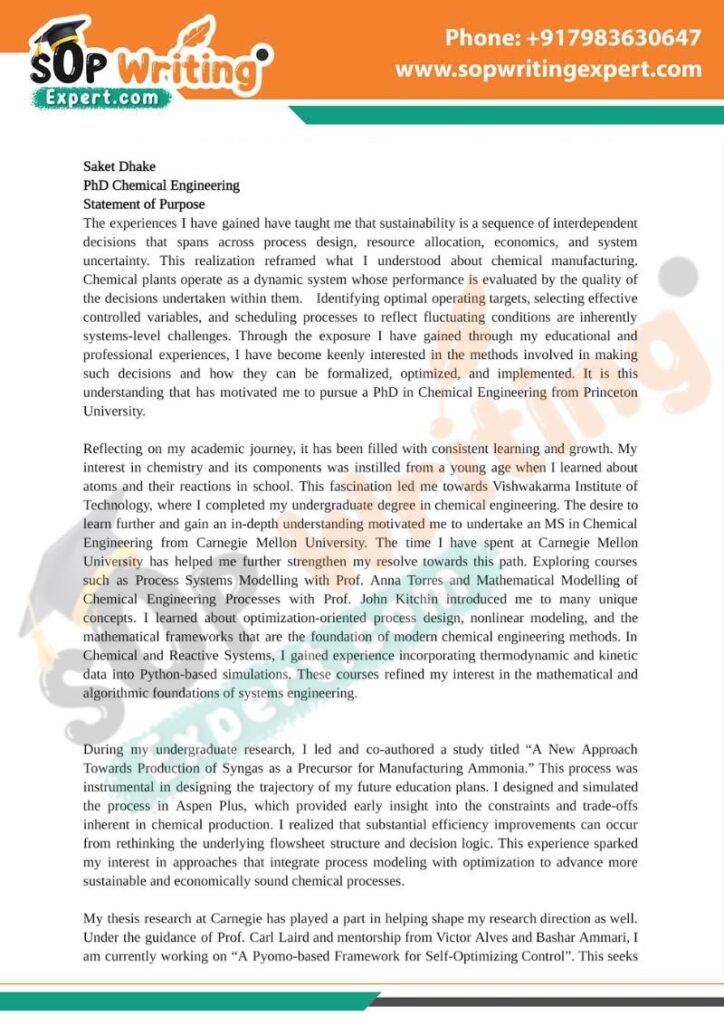
It’s not a full SOP 📱 Need Help in SOP Review? WhatsApp: +91 79836 30647
Top Universities for Chemical Engineering
| University | Country | Why Choose It |
|---|---|---|
| MIT | USA | World-leading research in process and materials engineering |
| Stanford University | USA | Strong energy and sustainability-focused programs |
| University of Cambridge | UK | Renowned chemical engineering research heritage |
| University of Toronto | Canada | Strong industry ties and research funding |
| University of Melbourne | Australia | Excellent biochemical and process engineering labs |
| Imperial College London | UK | Top-ranked chemical engineering department |
| National University of Singapore | Singapore | Cutting-edge research in green chemistry |
| ETH Zurich | Switzerland | High research output in process systems engineering |
| University of Manchester | UK | Strong links with the chemical and energy industries |
| TU Delft | Netherlands | Strong focus on sustainable process engineering |
Conclusion
Writing a strong SOP for Chemical Engineering takes time, honesty, and attention to detail — but it’s worth every bit of effort, since it’s often the deciding factor in a close admissions decision. Focus on being specific about your background, your interest in the field, and why a particular university and program fit your goals. If you want expert guidance or a personalized SOP sample, our team is just a message away.
Frequently Asked Questions (FAQs)
What should I include in an SOP for Chemical Engineering?
Your SOP should include your academic background, relevant projects or internships, your specific interest within chemical engineering (like process design, biochemical engineering, or energy systems), why you chose that particular university, and your career goals. Keep it structured, specific, and free of generic statements that could apply to any applicant or any field.
How long should an SOP for Chemical Engineering be?
Length depends on the level you’re applying for. Bachelor’s SOPs are usually 600–800 words, Master’s or MS SOPs run 800–1000 words, and PhD SOPs typically need 1000–1200 words. Always check your target university’s specific word limit, since some programs set strict caps that differ from these general guidelines.
Is a Personal Statement different from an SOP?
Yes, though they’re closely related. A Personal Statement tends to be more narrative and personal, commonly used for UK undergraduate applications, while an SOP is more structured and goal-oriented, common in the US, Canada, and Australia. Always confirm which one your target university requires before you start writing.
Can I use the same SOP for multiple universities?
No, You can reuse the core structure, but you should never submit an identical SOP to multiple universities. Each SOP should mention specific faculty, labs, or program details relevant to that particular university. Admissions committees can easily tell when an SOP is generic or copy-pasted, which can hurt your chances.
Is an SOP required for both Bachelor’s and Master’s programs?
Yes, most universities require an SOP for both levels, though expectations differ. Bachelor’s SOPs focus more on curiosity and foundational interest, while Master’s and PhD SOPs expect stronger academic depth, research exposure, and a clearer sense of specialization within chemical engineering.
What makes an SOP for Chemical Engineering stand out?
Specificity is what separates a strong SOP from an average one. Mentioning real projects, actual challenges you solved, and precise reasons for choosing a university’s program — rather than generic praise — makes your SOP memorable. Admissions officers read hundreds of SOPs, so authenticity and detail matter far more than fancy language.
Do I need research experience for an SOP for PhD in Chemical Engineering?
Prior research experience strongly strengthens a PhD SOP, since PhD programs are evaluated heavily on research fit and readiness. If you don’t have formal research experience, focus on relevant projects, coursework, or independent study that demonstrates analytical thinking and genuine interest in a specific research area.
Should I mention specific faculty members in my SOP?
Yes, especially for Master’s, MS, and PhD applications. Naming specific faculty members whose research aligns with your interests shows the admissions committee that you’ve done your homework and have a genuine reason for choosing that university, rather than applying randomly to multiple schools.
Contact for SOP or Personal Statement Writing : WhatsApp: +91 79836 30647